
Artículo: Best Year-Round Vessel Readiness for Broker Verification

Best Year-Round Vessel Readiness for Broker Verification
Table of Contents
- Why Year-Round Vessel Readiness Matters for Broker Verification
- The Charter Yacht Inspection Checklist Every Owner Needs
- How to Build a Yacht Maintenance Log Template That Satisfies Brokers
- Creating a Vessel Condition Report for Brokers: What to Include
- Professional vs. DIY Maintenance: A Cost-Benefit Analysis
- Common Mistakes That Jeopardize Vessel Readiness and Broker Trust
- Conclusion: Turning Maintenance Into a Verifiable Asset
- Frequently Asked Questions
Last Updated: October 3, 2026
Why Year-Round Vessel Readiness Matters for Broker Verification
Vessel readiness is the state of a yacht being fully operational, clean, and documented well enough to pass a broker's or surveyor's inspection without surprises.
Owners who keep vessels charter-ready all year walk into a sale or new charter season with proof; those who don't end up explaining problems instead of pricing assets.
Here's the part most owners get wrong: they treat maintenance as a cost. Brokers treat it as evidence.
A broker's job is to verify condition, not take your word for it.
Below, we'll show you how to build a maintenance system that satisfies brokers, surveyors, and charter clients at once, covering five areas: inspection checklists, maintenance logs, condition reports, the professional-versus-DIY decision, and the mistakes that quietly destroy trust.
The Charter Yacht Inspection Checklist Every Owner Needs
Start with these systems, and inspect them in this order:
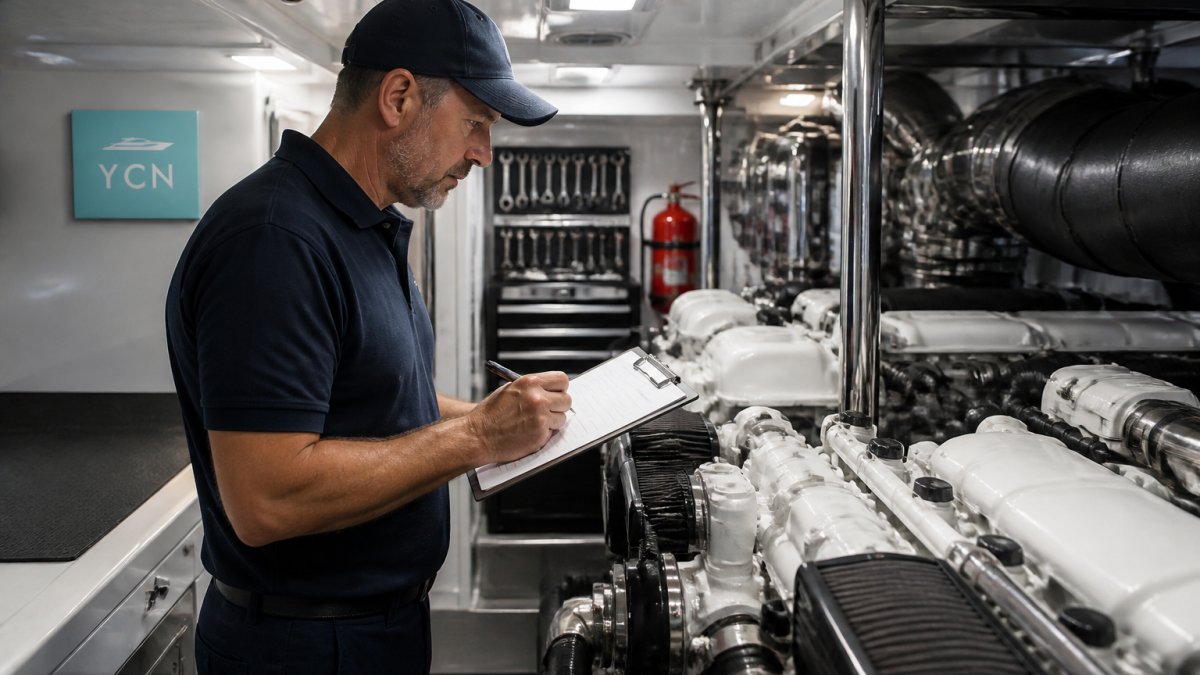
- Hull and topsides - look for gel coat cracks, blisters, and waterline stains
- Engine and mechanical systems - check for leaks, belt wear, and unusual noise at idle
- Fuel lines and filters - inspect for cracking, weeping fittings, and water in the separator
- Bilge and fluid levels - confirm the bilge is dry and every fluid sits at its mark
- Electrical panels and battery health - test voltage, terminals, and breaker function
- Safety gear - verify life jackets, flares, extinguishers, and their expiration dates
- Documentation - confirm registrations, insurance, and service records are current
Corrosion control belongs on every pass, not just the annual one. Salt air attacks fittings, rails, and electrical connections continuously, and an idle vessel corrodes faster than one in regular use.
What most guides miss is the order. Surveyors work bow to stern and top to bottom; inspect in the same sequence and you'll find the same problems they will, just earlier.
How to Build a Yacht Maintenance Log Template That Satisfies Brokers
A yacht maintenance log template ties every task to a date, a person, a result, and a piece of evidence. Brokers don't want a diary, they want a document they can scan in two minutes and trust, in a format they can forward to a surveyor or insurer without retyping anything.
Build yours with these columns:
| Column | What to Record | Why Brokers Care |
|---|---|---|
| Date | Day the work was done | Proves the schedule was followed |
| System | Engine, electrical, bilge, hull | Shows coverage across marine systems |
| Task | What was checked or replaced | Confirms mechanical reliability |
| Engine hours | Reading at time of service | Ties maintenance to actual use |
| Fluid analysis | Oil or coolant sample results | Detects wear before failure |
| Provider | You or a named technician | Establishes professional management |
| Parts and part numbers | Manufacturer and SKU of anything replaced | Lets a surveyor verify the correct spec was used |
| Evidence | Photo, receipt, or report | Turns claims into documentation |
Why Digital Logs Beat Paper at Verification Time
A paper log proves you wrote something down. A digital log proves the work happened, when, and by whom, and can be searched, exported, and shared in seconds. That matters at three moments:
- Pre-listing. A broker wants the last 24 months of service in one view. A spreadsheet filtered by system and date does that; a notebook does not.
- Survey. A surveyor will ask for engine hours, impeller replacement dates, and battery age. Answers found in ten minutes flag a gap; answers found in ten seconds let the surveyor move on.
- Insurance and charter compliance. Underwriters and charter operators increasingly require documented maintenance before binding coverage or accepting a vessel. A digital log with dated entries and receipts answers that directly.
What to Attach to Each Entry
An entry without evidence is a claim. Attach at least one of the following to every non-trivial task:
- A dated photo of the component before and after service
- A receipt or invoice showing parts and labor
- A fluid analysis report from a lab
- A signed service report from a named technician or yard
Store these in the same folder structure as the log, one folder per year, one subfolder per system. When a broker asks for the electrical history, you send one link, not twelve attachments.
The Two Habits That Separate a Useful Log From a Useless One
First, log the small stuff. A note that you topped off coolant in March tells a surveyor you were paying attention; a hose clamp replaced in June tells them you catch problems before they become findings.
Second, log as you go, not after the fact. Reconstructed records look reconstructed, and a broker who has reviewed a hundred vessels can tell the difference.
Digital logs also solve the memory problem. Nobody remembers which impeller was replaced two seasons ago, and a broker will ask. The log is not a chore, it turns maintenance spending into a verifiable asset at sale or charter.
Creating a Vessel Condition Report for Brokers: What to Include
A vessel condition report for brokers is a structured summary of the yacht's current state, backed by the maintenance log. It should read like a status update, not a sales pitch.
Include these sections:
- Systems status - engine, generator, electrical, plumbing, and navigation, each marked good, watch, or needs work
- Recent work - what was serviced in the last twelve months, with dates
- Known issues - disclosed honestly, with your plan and timeline to fix them
- Documentation - survey history, registration, insurance, and warranty papers
- Photos - dated images of key systems and any repaired areas
Honesty here is not charity. A disclosed issue already scheduled for repair builds more trust than a spotless report a surveyor can pick apart.
Pair the condition report with the maintenance log and you've built the two documents every broker asks for first. Everything else is detail.
Professional vs. DIY Maintenance: A Cost-Benefit Analysis
Professional maintenance costs more per visit than DIY, but usually less over a full ownership cycle. Not because professionals turn wrenches better, but because their work produces three things DIY rarely does: earlier fault detection, standardized documentation, and a verifiable service history insurers and buyers actually weigh. Consistent attention to sailing hardware maintenance ensures that these critical components remain within their operational tolerances, thereby preventing the minor wear that eventually necessitates expensive emergency repairs.
Run the comparison honestly:
| Factor | DIY | Professional Management |
|---|---|---|
| Upfront cost | Lower per task | Higher per task |
| Skill ceiling | Limited to your knowledge | Full marine systems expertise |
| Diagnostic tools | Whatever you own | Manufacturer-level diagnostics |
| Documentation | Whatever you write down | Standardized, verifiable records |
| Insurance posture | Neutral to weak | Strengthens underwriting case |
| Resale impact | Neutral | Strengthens marketability |
| Time required | Significant | Minimal for the owner |
The Insurance Mechanism Most Owners Miss
Insurers price marine risk on condition and history, not intentions. A vessel with documented annual service, recent fluid analysis, and a named technician on record presents lower perceived risk than an identical vessel with a blank maintenance file. That difference shows up in three places:
- Underwriting questions. When an application asks for the last service date on engines, generator, and fire systems, a documented answer processes faster and is less likely to trigger a condition survey.
- Claims review. After a loss, an adjuster asks what maintenance was performed. A log with dates and receipts supports the claim; a verbal account does not.
- Charter and marina requirements. Many charter programs and some marinas require proof of recent professional service. DIY records are often accepted only with receipts and photos.
The Resale Math, Stated Plainly
A surveyor's findings become the buyer's negotiating lever. If a survey turns up a failed battery bank, weeping fuel fitting, or overdue impeller, the buyer asks for a discount larger than the repair would have cost. The same holds for deferred engine service, expired safety gear, and undocumented electrical work.
Professional maintenance does not eliminate survey findings. It reduces their number and severity and gives you a documented answer for each that remains, the difference between a buyer who negotiates and one who walks.
Where DIY Still Wins
DIY is right for cleaning, fluid top-offs, monthly visual checks, and simple replacements you can do correctly with the right tools and a torque spec.
Most owners land on the middle path: handle routine work yourself and bring in professionals for annual service, pre-season commissioning, and pre-sale survey preparation. That split keeps costs predictable while keeping documentation strong enough for a broker, surveyor, and underwriter.
The honest framing: DIY saves money on tasks you can do correctly and document properly. Professional management saves money on everything else, converting maintenance spending into evidence that protects resale value and insurance standing.
Common Mistakes That Jeopardize Vessel Readiness and Broker Trust
The fastest way to lose a buyer's confidence is a maintenance gap they discover before you mention it. Most of these mistakes are avoidable and cheap to fix.
- Letting the vessel sit idle. An idle vessel develops flat batteries, stale fuel, and seized fittings. Run systems regularly, even in the off-season.
- Logging work after the fact. Reconstructed records look reconstructed. Log as you go.
- Ignoring small leaks. A weeping fitting today is a corroded fuel line next season.
- Skipping the pre-season commissioning. Splash preparation done properly prevents the first-week failures that ruin a charter.
- Treating the survey as the deadline. By then, every finding is a discount, not a repair.
- Using vague language in reports. "Engine checked" tells a broker nothing. "Impeller replaced at 1,240 hours" tells a story.
Storage protocols matter too. A yacht laid up without proper fuel treatment, battery care, and ventilation returns with problems that show up in the survey. Planning for storage as carefully as for the season protects both vessel condition and resale value.
Conclusion: Turning Maintenance Into a Verifiable Asset
The challenge is consistency. Anyone can clean a boat before a showing. Fewer owners can produce two years of dated records showing every system tested, every fluid analyzed, and every issue disclosed and resolved.
That record turns maintenance from a cost into an asset. It supports resale value, satisfies brokers and surveyors, and keeps your vessel ready for charter on short notice.
YCN offers access to more than 1,700 term-charter yachts worldwide, with experienced captains and crew.
Get a quote from YCN and put your vessel's readiness to work.
Frequently Asked Questions
Which of the following is recommended maintenance for an inboard?
For inboard engines, recommended maintenance includes checking the oil level and condition before each trip, inspecting the cooling system for leaks, replacing the fuel filter annually, and monitoring engine hours to schedule professional servicing. A professional maintenance log that tracks these tasks helps brokers verify that the engine has been cared for, which supports vessel readiness and resale value.
What documentation is required for professional yacht maintenance records?
Professional maintenance records should include a yacht maintenance log template that records the date, engine hours, work performed, parts replaced, and the technician or company name. Supporting documents like fluid analysis reports, receipts, and a vessel condition report for brokers add credibility. Brokers and surveyors look for a consistent, chronological record that shows preventative maintenance was done on schedule.
How does a professional maintenance log impact yacht charter broker verification?
A professional maintenance log gives brokers verifiable proof that the vessel has been maintained to a consistent standard. It reduces uncertainty during broker verification, speeds up the listing process, and can increase charter profitability by minimizing downtime. A well-kept log also supports a higher resale value because it demonstrates proactive care and asset longevity.
What are the essential components of a year-round yacht maintenance schedule?
A year-round schedule covers monthly, quarterly, and annual tasks. Monthly items include checking fluid levels, battery health, and bilge cleanliness. Quarterly tasks involve engine inspections, fuel line checks, and electrical panel testing. Annually, schedule a professional vessel survey, corrosion control treatment, and systems testing. This schedule keeps the vessel ready for charter and broker inspection at any time.



























Dejar un comentario
Este sitio está protegido por hCaptcha y se aplican la Política de privacidad de hCaptcha y los Términos del servicio.